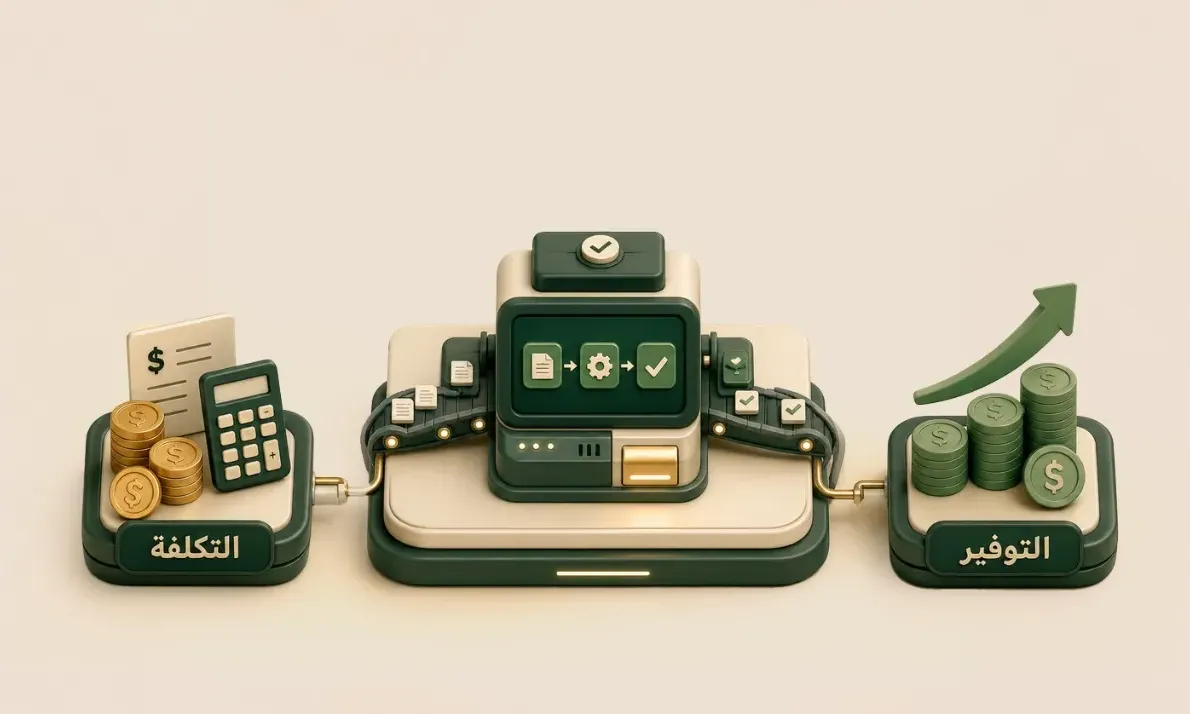
The question on every business owner's mind isn't "how much does automation cost?" but "how much will it save me against what I pay?". At Nasq4, we treat automation as an investment with a calculated return, not an expense — we analyze your operations first, calculate what you spend today on manual tasks, errors, and wasted time, then build you an automation system at a competitive price that recovers its cost quickly. In this guide, we put in your hands the real cost factors, an approximate pricing table, and how to calculate savings and return, so you know exactly what you pay and why — before you make your decision.
1. What Is Business Automation? And Why Has It Become a Necessity?
Business automation means replacing repetitive manual tasks with systems that perform them automatically — from issuing invoices and tracking orders, to responding to customers and managing inventory and human resources. The goal isn't to dispense with employees, but to free them from routine work so they focus on what creates real value.
And in the Saudi market specifically, with Vision 2030 and requirements like e-invoicing, automation has become not a luxury but a condition for competitive survival. The real question isn't "should I automate?" but "for how much, and how much will it return to me?".
2. Factors That Determine the Cost of Business Automation
There is no single price for automation, because every business differs. But the final cost is determined by clear factors we explain transparently so you know what you're paying for:
- The scope of automated operations: automating a single task (like invoicing) differs radically from automating a complete system (sales + inventory + HR).
- The number of integrations: the more systems linked together (store + accounting + payment + shipping), the greater the technical work and cost.
- Ready-made or custom: subscribing to a ready system differs from building one tailored exactly to your operations.
- The level of AI: simple rule-based automation is cheaper than smart automation that learns and makes decisions.
- Compliance and security: compliance with ZATCA and the data-protection law adds a necessary, indispensable cost.
- Support and maintenance: ongoing development and post-launch support are part of the long-term cost.
3. An Approximate Automation Cost Table in Saudi Arabia
To clarify the picture transparently, here are approximate ranges to help you estimate what suits your business size (varies by complexity and integrations):
| Level | Suitable For | Usually Includes |
|---|---|---|
| Single-task automation | A small business solving a specific pain | Automating one process (invoicing, reminders, replies) |
| Department automation | Small and medium businesses | Automating a full department (sales or inventory) + dashboard |
| Integrated system | Medium and large | Linking several departments + integrations + reports |
| Smart automation (AI) | High-volume businesses | AI that learns, makes decisions, and predicts |
4. Ready-made or Custom? Its Impact on Cost
One of the most important decisions determining your long-term cost: do you subscribe to a ready system or build a custom one? The table makes it clear:
| Criterion | Ready-made (Subscription) | Custom (Ownership) |
|---|---|---|
| Cost | Recurring monthly fees forever | A one-time development payment |
| Start | Fast and instant | Needs development time |
| Fit to Your Business | You adapt to the system | The system is tailored to your operations |
| Cost as You Grow | Balloons with users | Fixed, you own the system |
| Best For | Startups and standard needs | Unique operations and long-term growth |
For a deeper look, see our article on the best ERP systems in Saudi Arabia, which explains the difference between ready-made and custom in detail.
5. How Much Do You Save? The Return-on-Investment (ROI) Calculation
Cost alone is half the picture. The more important half is the return: how much will automation save against what you pay? The formula is simple:
and Payback period = system cost ÷ monthly savings.
And where do the savings come from? From three main sources:
⏱️
Time Savings
Manual work hours that turn into seconds = salaries directed to more important work.
❌
Fewer Errors
Every error in an invoice or inventory costs money and correction time — automation eliminates it.
📈
Higher Productivity
A team freed for growth and sales instead of routine = higher revenue.
6. A Worked Example: How Much Do You Actually Save?
Let's assume a company spends significant time on a repetitive task (like entering orders and invoices manually). Here's a simplified approximate calculation:
| Element | Estimated Value |
|---|---|
| Manual work hours per month | 160 hours (roughly one full-time employee) |
| Average cost per hour | 40 SAR |
| Monthly cost of the task done manually | ≈ 6,400 SAR |
| Share of the task systems automate | ≈ 70% |
| Monthly savings after automation | ≈ 4,480 SAR |
| Approximate annual savings | ≈ 53,760 SAR |
7. Hidden Costs Many Overlook
When comparing offers, don't look at the advertised price only. There are items that get forgotten and surprise you later:
- Annual maintenance: often estimated as a percentage of development cost — plan for it from the start.
- Hosting and infrastructure: an ongoing monthly cost that varies by data size and usage.
- Training and change management: training your team on the system is part of the project's success.
- Future integrations: linking new systems later may need additional development.
- VAT: confirm whether the price includes tax or not.
8. Compliance as a Cost Factor (ZATCA and Data Protection)
In Saudi Arabia, compliance isn't optional but part of the cost of any serious automation system. Ignoring it exposes you to risks and fines greater than the cost of building it correctly:
🧾
E-invoicing (ZATCA)
Any system touching invoicing must comply with the Zakat, Tax and Customs Authority's requirements.
🔐
Data Protection (PDPL)
Compliance with the Saudi Personal Data Protection Law.
🛡️
Cybersecurity
Protection standards that safeguard your data and your customers' data.
And if your business relies on invoicing, see our guide on linking your store to e-invoicing (ZATCA) to understand the compliance requirements and their cost.
9. How to Lower Automation Cost Without Lowering Quality?
- Start with the biggest pain: automate the task that consumes the most time or causes the most errors first, to achieve a fast return.
- Go gradually, not all at once: build a core then expand it, instead of a huge system in one go.
- Choose the right solution, not the biggest: don't pay for features you won't use.
- Ensure code ownership: a system you own saves you recurring fees in the long run.
- Measure before and after: calculate the savings in practice to know what's worth expanding.
10. Why Nasq4 for Automating Your Business?
At Nasq4, we are a Saudi software company that builds custom automation systems tailored to your business — with high quality and a competitive price, and full ownership of the code and data. We always start by calculating the return before the cost:
- Analyzing your operations and calculating what you actually spend before writing any code.
- Systems compliant with ZATCA and Saudi data protection.
- Gradual building that starts with the highest return and expands as you grow.
- Ongoing support and development after delivery.
Learn more about our services in business automation systems for Saudi companies, and how AI raises automation efficiency.