
As the digital transformation accelerates, designing an e-library app has become one of the most important tools for educational institutions, publishing houses, and individuals to disseminate knowledge and reach a wide audience. Whether you want to showcase your books, build a platform for selling and renting digital books, or transform your traditional library into a smart platform, a library app opens the door to wider reach and profit. With Nasq4, we’ll transform your idea into a fully integrated knowledge platform that you own entirely and that grows with you.
1. Why has designing an e-library app become a powerful opportunity for digital content and education?
At a time when digital content has become an essential part of education and self-directed learning, the e-library is no longer just an add-on—it’s a digital project serving a broad audience seeking quick and organized access to books and reference materials from anywhere. The power of this type of app lies not only in displaying books but also in its ability to transform into a comprehensive educational and cultural platform that combines reading, research, and subscriptions into an experience tailored to students, researchers, and readers.
- Ease of Access: Books and reference materials anytime, from any device.
- Greater flexibility: Add and update content without the complications of printing and distribution.
- Quick search within content: An important feature for students and researchers.
- Clear revenue model: through subscriptions, content sales, or paid access.
- Wide audience: From individual readers to educational institutions and training centers.
- Scalability: Starts as a digital library and evolves into a comprehensive knowledge platform.
2. Who Are We Designing For? The Beneficiaries of the Library App
The library app isn’t aimed at a single group; rather, we’re designing it to suit a wide range of projects—each of which will find a place within it:
🏛️
Traditional libraries
Transforming a physical library into a sophisticated digital platform that reaches a wider audience.
🎧
Audiobook platforms
Specializing in novels and audiobooks for an audience of listeners.
🎓
Academic institutions
Academic books and reference materials for students, universities, and training centers.
✍️
Self-publishing
A platform that allows authors to publish their books without intermediaries.
🧒
Interactive Children’s Books
Illustrated and interactive books for children and young adults.
🏙️
Cultural Institutions
Digitizing public libraries and making them accessible to everyone.
3. Ways to Monetize an E-Library App
In addition to the educational value, there are real and scalable revenue opportunities that can transform the app from a reading platform into a sustainable digital business:
📖
Paid Books
Selling exclusive books or series while sharing profits with publishers and authors.
📢
Targeted ads
Educational and cultural ads that do not interfere with the reading experience.
🤝
Institutional Sponsorship
Partnerships with universities, schools, and government agencies to support the app.
🎬
Courses and interactive content
Courses, audio files, and videos sold separately or as part of bundles.
🏅
Points and Rewards System
Encouraging engagement and converting points into benefits and discounts.
🖨️
Print-on-demand
Print a hard copy for a fee—for those who love reading on paper.
4. Learn About Nasq—Saudi Expertise in App Design
In a Saudi market experiencing rapid digital transformation, Nasq stands out as a specialist in digital business solutions, combining technical creativity with an understanding of Saudi user behavior to build digital products that deliver real results. We follow a clear methodology: Analysis – Planning – Design – Implementation. Our core services include:
Since the library app is part of the broader world of mobile apps, you can learn more about our comprehensive services on our Mobile App Design Company in Saudi Arabia page.
5. How is a professional e-library app designed, from concept to launch?
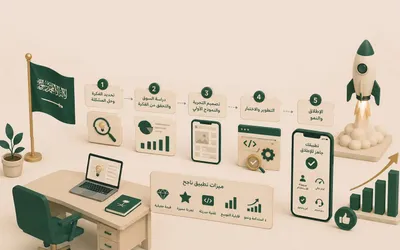
Designing a successful e-library app doesn’t start with uploading books; rather, it goes through clear stages that directly impact the app’s quality and its ability to attract and retain users:
Analyzing the Concept and Content Type
We understand the nature of the library and its content (books, reference materials, audio, video) and analyze the audience and its needs.
Defining Features and Mapping the User Experience
We define categories, search, reading, downloading, and subscriptions, and map out a structured user journey.
Designing User-Friendly Interfaces
Clarity, readability, and quick access to books, combined with an attractive visual identity.
Development, Integration, and Security
Integration with a content and subscription dashboard, including content protection and copyright safeguards.
Testing, Launch, and Optimization
Comprehensive testing of navigation, reading, and account features, followed by launch, monitoring, and continuous improvement.
6. Key Features That Must Be Included in the App
There are features that serve as the cornerstone of any successful library app:
🔍
Smart search within books
Quick access to content via keywords.
📱
A comfortable built-in reader
A seamless in-app reading experience.
🗂️
Diverse Categories
By topic or genre to make browsing easier.
⬇️
Offline Download
Read books anytime without an internet connection.
🎧
Audiobooks
Support for audio content for listeners.
🔖
Bookmarks
Save your last page and pick up where you left off.
⭐
Ratings and Reviews
User opinions build trust.
❤️
Favorites
Save books to come back to later.
🌐
Multilingual
Arabic and English within the app.
💳
Purchase and Subscription
Flexible access to premium content.
🔔
Release Notifications
Alerts for new content and offers.
🖥️
Full Control Panel
Easily manage and add content.
7. Features of the Digital Library App Design (Administration – Users)
The app serves two parties, each with its own screen and tools:
Administration Dashboard
- Easily manage content and books
- Add and edit sections and categories
- Control user permissions
- Track reading statistics
- Send Instant Notifications
- Complaint Management System
- Filter and organize content
- Activate or deactivate accounts
- Manage Payments and Subscriptions
- Upload PDFs and audio files
- Integration with External Systems
- Customize the app’s appearance
- Regular Reports and Analytics
- Set up policies and privacy settings
- Multi-level control panel
User Interface
- Easy and Fast Book Browsing
- Smart keyword search
- Add to Favorites
- Save Last Page Read
- Download books to read later
- Night mode
- Share Links
- Rate and Write Reviews
- View audio and video content
- Alerts for new books
- Support for multiple languages
- Personalized interface based on interests
- Flexible subscription system
- Read without logging in
- Contact Technical Support
8. Types of Content Supported Within the App
We’re building the app to support multiple types of content, making it a comprehensive knowledge platform—not just a book showcase:
📄
E-books
in PDF and EPUB formats.
🎧
Audiobooks
Audio content for listening on the go.
🎬
Educational videos
Visual explanations and lessons.
📰
Articles and Journals
Scientific content and specialized journals.
📑
Research and documents
Student papers and research.
📊
Presentations
Educational PowerPoint slides.
🌍
Multilingual content
Serves an Arab and global audience.
🧩
Interactive files
HTML and SCORM for interactive learning.
✅
Quizzes and exercises
Short quizzes to reinforce knowledge.
9. App Security, Content Protection, and Copyright
In the age of digital content, protecting intellectual property and securing user data have become among the most critical challenges for library apps. A successful app does more than just provide books; it ensures the highest level of content security—and this is our strength:
- Data Encryption: Encrypting content and user data using advanced protocols such as HTTPS and AES.
- Protection Against Copying and Downloading: Prevent screen capture or content copying, and a built-in reader that prevents external saving.
- Digital Signature and Watermark: An invisible mark on books to track any stolen copies.
- Copyright Compliance (DRM): Integration with internationally recognized digital rights management systems to prevent unauthorized distribution.
- Precise Permissions and Monitoring: Defined access levels and real-time activity tracking with alerts for unusual attempts.
- Pre-approval: No content is published until its licensing or the owner’s permission has been verified.
10. Subscription Systems and Access Rights Management
A flexible subscription system that transforms the app into a professional, profit-generating venture, with precise control over who has access to what:
- Multiple plans (Free – Monthly – Annual – Premium) to suit different users.
- Set the access level for each user based on their subscription type.
- Control over usage duration or the number of reads and downloads.
- Limit an account to a specific number of devices to prevent misuse.
- Protect content and prevent unauthorized sharing.
- A control panel to track subscriptions and statistics and manage permissions.
11. How does the library app evolve from a simple idea into a comprehensive knowledge platform?
A successful app doesn’t just display books; it evolves into a comprehensive knowledge platform that users engage with daily—one that combines reading, learning, interaction, and repeat visits. This transformation doesn’t happen by simply adding more books, but by building smart features:
📚
Clear content paths
Organizing books into interconnected paths and levels rather than a large archive.
🔍
Smart search and browsing
Search tools and suggestions that improve the speed and accuracy of access.
🎧
Multi-format content
Audiobooks, summaries, and visual and interactive content.
✅
Interaction and Assessment Tools
Quizzes, achievement badges, and progress indicators.
👥
A community centered around content
Comments, reviews, reading lists, and clubs.
🏫
Institutional Expansion
Services for schools and centers, including libraries, permissions, and custom reports.
12. How do you choose a reliable e-library app design company in Saudi Arabia?
When choosing a company to design a professional e-library app, it’s essential to base your decision on actual experience and quality of execution, not just on price.
- Look for a company with a proven track record in educational apps, and review their portfolio.
- Make sure the team is proficient in Flutter, React Native, and Swift and has experience with content management and security systems.
- Choose a company that offers a comprehensive solution: analysis, design, programming, testing, and post-launch support.
- Effective communication and transparency in delivery and contracts reflect professionalism and trust.
- Be wary of excessively low bids, as they may result in a subpar app that ends up costing you more later on.