Companies spend heavily on exhibitions and events, yet many just greet visitors and collect cards with no plan to convert them — so the event ends with a box of cards, not deals. A successful event isn't measured by attendance, but by the deals it produces: every visitor is an opportunity, and every interaction is the start of a relationship that could become a loyal customer. In this guide we take you step by step to turn your event into a lead-generation machine — and at Nasq4 we help you build that system with professional organization and a digital dimension that measures every riyal you spend.
1. Success Starts a Month Before the Event, Not on the Day
The first mistake is to start thinking about results on event day. The truth is deals are made in the advance preparation. Weeks before the event, define your goal clearly: how many leads do you want? Who is your target audience? What message will you deliver?
Then promote your presence in advance via social media and email, invite your prospects to visit your booth, and prepare your team and marketing materials. An event you plan well starts full of opportunities; one left to chance starts empty.
2. Design a Booth That Stops the Visitor from Walking By
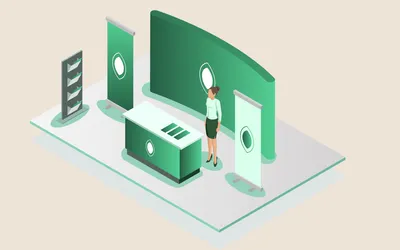
In an exhibition crowded with dozens of booths, you have seconds to catch the visitor's attention before they pass. Your booth is your first impression, and its design determines whether the visitor stops or keeps walking:
👁️
Eye-Catching Design
A visual identity and colors that draw the eye amid the crowd.
💬
A Clear Message
The visitor understands what you offer in a single second.
✨
An Attraction Element
A screen, experience, or show that sparks curiosity.
🚪
A Welcoming Space
An open design that invites entry, not one that looks closed.
3. Turn Your Team into Opportunity Hunters, Not Receptionists
The best booth fails with a passive team that waits for the visitor to ask. Your team is your living front, and the way they interact makes the difference between a visitor who passes and a customer who converts. Train your team to take the initiative with a smile and an open question that starts a conversation, not "Can I help you?" which is met with "No, thanks."
Teach them to listen more than they speak, to understand the visitor's need before offering the solution, and to focus on building a relationship rather than dumping information. The visitor forgets what you said but remembers how you treated them.
4. Collect Visitor Data Smartly, Not Randomly
The most valuable thing you leave an event with isn't immediate sales, but the lead data you follow up on afterward. But collecting cards randomly with no system makes them worthless. Collect data in an organized way that eases follow-up:
- Digital registration form: a tablet or QR code that captures data directly and organized.
- An incentive to register: a raffle, gift, or special offer that encourages the visitor to leave their data.
- Record the interest: note what matters to each visitor to tailor your follow-up later.
- Classify immediately: distinguish the serious visitor from the curious one at registration time.
- Link to your system: move data straight to your CRM, not to paper that gets forgotten.
5. Offer an Unforgettable Interactive Experience
The visitor forgets brochures and talk, but remembers the experience. So instead of telling them about your product, let them live it. An interactive experience creates a deep impression and makes your booth the talk of the exhibition:
🖥️
Live Demos
Show your product or service working in front of the visitor directly.
🎮
Interactive Experience
Touch screens, virtual reality, or competitions that draw people in.
🎁
Thoughtful Gifts
A useful gift carrying your brand that stays with the visitor after the event.
📸
A Moment Worth Capturing
An attractive corner the visitor shares on their accounts, spreading your brand.
6. Classify Your Visitors by Seriousness Immediately
Not every visitor is a prospect, and treating everyone the same wastes your time. The smart move is to distinguish — during the event — between the serious visitor ready to buy and the curious one just browsing, so you focus your effort and follow-up on who deserves it:
🔥
Ready Customer
Genuinely interested with a need and a budget — top priority.
🌱
Potential Customer
Interested but needs time and persuasion — regular follow-up.
👋
Curious Visitor
Browsing with no intent to buy — light contact without pressure.
🤝
Potential Partner
Not a customer but a future collaboration or partnership opportunity.
7. The Visitor-to-Customer Funnel: Where It Starts and When It Closes
Converting a visitor into a customer isn't a single moment, but a journey through stages. Understanding this funnel lets you know where to place your effort at each stage instead of treating every visitor the same:
- Top of funnel (awareness): an eye-catching booth and a clear message stop the largest number of visitors.
- Middle of funnel (interest): conversation, an interactive experience, and capturing data from those genuinely interested.
- Bottom of funnel (decision): personalized follow-up, an offer, and a next step that turns the interested into a deal.
The rule: each stage loses part of the visitors, so the wider the top of the funnel (more visitors) and the less the leakage at each stage (a better experience and follow-up), the more deals you get in the end.
8. Post-Event Follow-up Is What Makes the Deals
Here the race is won or lost. Most companies return from the event, get busy, and forget to follow up, losing all the opportunities they gathered. The truth is that most deals close after the event, not during it, and whoever follows up fast and smartly wins:
- Follow up fast: reach out within 48 hours while the event is still in the visitor's memory.
- Personalize your message: remind them of what you discussed, not a cold generic message.
- Offer the next step: a proposal, meeting, or sample that pushes toward the deal.
- Don't give up quickly: most deals need more than one follow-up.
- Stay in touch: even someone not ready today may buy tomorrow if you stay in their mind.
9. The Exhibition ROI Formula: How Do You Know Your Event Succeeded?
An exhibition is an investment, and an investment is measured by its return, not your impression of it. Calculating the return is simply comparing what you earned in deals with what you spent on participating:
| Metric | What it measures | Why it matters |
|---|---|---|
| Cost per lead | Total cost ÷ number of leads | Reveals the efficiency of your booth spend |
| Conversion rate | Number of deals ÷ number of leads | Measures follow-up quality, not visitor quantity |
| Return on investment (ROI) | (Deal value − cost) ÷ cost | The decisive number: did the event profit or lose? |
The key point: you can't calculate any of this without organized data. This is where the value of digital registration and linking visitors to a CRM appears — without numbers to measure, your event's success stays a mere impression.
10. Employ Digital Presence in Service of Your Event
A modern event doesn't live in the hall only; its impact extends digitally before, during, and after it. Integrating the digital dimension multiplies its results and turns it from a temporary happening into an integrated campaign:
📱
An Event App or Page
Agenda, registration, and networking that ease the visitor's experience.
📣
Pre-Event Digital Promotion
Campaigns that attract your target audience before the event.
💻
Electronic Registration
Collecting visitor data easily, accurately, and organized.
📊
Results Analysis
Accurate data on attendance and engagement to measure success.
11. How Does Nasq Turn Your Event into a Real Sales Machine?
Everything above needs a partner who combines on-site organization and the digital dimension in one system — and that's the heart of our work. At Nasq4 we don't organize an event that ends when the day ends; we build it to generate customers and have its results measured:
🎪
Organization That Attracts
A booth, experience, and technical production that stop the visitor and start the conversation.
💻
Digital Registration
Capturing organized data linked to your system, not cards that get forgotten.
📊
Measurement & Analysis
Attendance, engagement, and return figures that prove your event's success.
🔁
Follow-up Tools
Ready data that eases following up a visitor's conversion into a deal.
We combine for you event and exhibition organization with its complete digital dimension — from the event app and electronic registration to digital marketing that reaches your audience — so you get an event with measurable results, not just attendance.
In the Yamama Cement event we combined professional organization and digital documentation, so the event came out with tangible results, not just attendance passing by.
Yamama Cement EventFrom Nasq4's work
Our philosophy is simple: an event whose results aren't measured isn't complete. So we build it digitally so you know exactly what it achieved.
Nasq4 TeamEvent Management
12. Common Mistakes That Waste Your Event's Opportunities + FAQ
Even with good preparation, some mistakes waste the opportunities you created. Watch out for them to protect your investment in the event:
- Settling for collecting cards: data without follow-up is worth zero.
- A passive team: waiting for the visitor instead of taking the initiative and starting the conversation.
- Neglecting follow-up: the biggest mistake that wastes most potential deals.
- An unclear message: a visitor who doesn't understand what you offer passes without stopping.
- Ignoring the digital dimension: an event without digital presence loses half its impact.
- No clear goal: an event without a defined goal is hard to measure the success of.